Background image with trees

Collaboration


As we build capacity for digital research, we collaborate across our sector in order to develop infrastructure and skills, explore responsible research practice and share knowledge and expertise.  Our collaborative work this year has focused on a few key strands: digital research infrastructure, research software engineering capacity, digital sustainability and the skills needed in the arts and humanities to engage effectively in our increasingly digital society.   
Logo for thr Collaborative Computational Project for Arts, Humanities and Culture

Toward a new CCP for Arts, Humanities, and Culture research

We are participating in the advisory group for a new scoping project led by Eamonn Bell (University of Durham). This project is exploring what a new Collaborative Computational Project (CCP) for the Arts, Humanities, and Culture (AH&C) research community could look like. With humanities researchers increasingly dependent on all aspects of digital research infrastructure (DRI)—including skills development, compute platforms, software techniques and the sustainable use of AI and HPC—this collaborative project will lead to the first network of its kind to support the AHRC research community, and will have a significant impact nationally and internationally.  The first CCP-AH Townhall was held in Durham in May 2025. 

black circle with the text una europa

AIHUMS101

Along with colleagues in Digital Education, CDCS is participating in the Una Europa project Artificial Intelligence & Humanities (101): Developing a Humanities Syllabus for AI & the Digital. Led by Cillian Ó Fathaigh (Jagiellonian University, Poland), with partners in Bologna, Edinburgh, Dublin, Leiden, Madrid and Leuven, the project will explore what students need in order to engage effectively with AI and digital technologies. The project is producing a survey on current teaching within Una Europa, a model syllabus of an introductory course to AI and the digital for humanities students and a toolkit for integrating AI into existing courses. 

Since 2021, CDCS has been a founding member of the Digital Humanities Climate Coalition, a collaborative and cross-institutional initiative focused on understanding and minimising the environmental impact of DH research. Participants are based at HE institutions and DH centres across the UK, Ireland and Northern Europe. DHCC is a Community Interest Group of the UK-Ireland Digital Humanities Association.

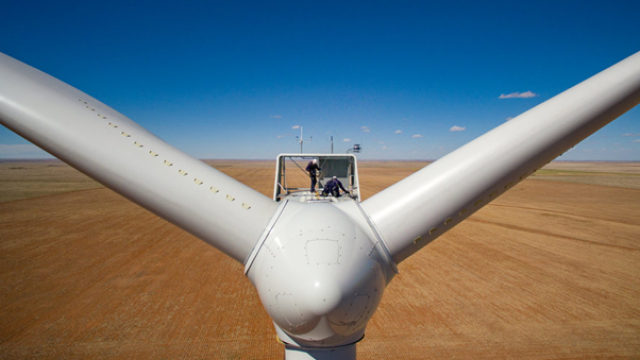
wind turbine

New DHCC Publication

Interpreting UKRI Environmental Sustainability Guidance for the Digital Humanities is a short guide aimed primarily at digital humanities researchers and research offices that exploes the policy resources underpinning the AHRC's sutainability statement. This publication offers a series of interpretations of existing guidance on sustainable research practice and points to advice on how to operationalise this guidance in DH research.


Uk Ireland DH Assocation Logo

Talks and workshops

The DHCC community continues to meet monthly online, and we frequently share the toolkit and the card game based on it with research and cultural organisations. This year, we held workshops at the UK-Ireland DH Association conference in Glasgow, at the Digital Research conference in Edinburgh and as part of our RSE Summer School in London. 

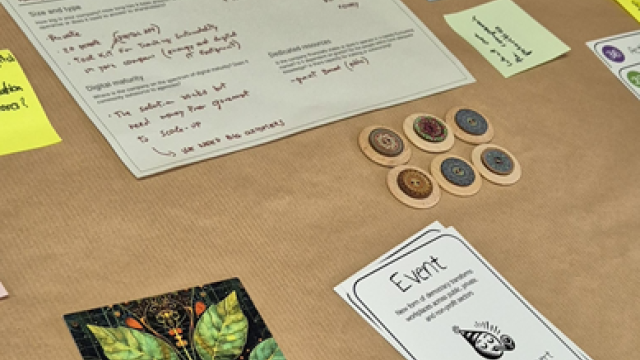
DHCC game being played

Digital Sustainability Card Game

Over the last couple of years, members of the DHCC have created a card game based on the contents of the DHCC Toolkit. In small groups, players act as organisations competing against (or perhaps collaborating with) the others to become more digitally sustainable. The toolkit contains an accessible guide to running a DHCC Workshop based on the Sustainability Card Game. We have shared this game with students, conference delegates and software developers and have received great feedback. 

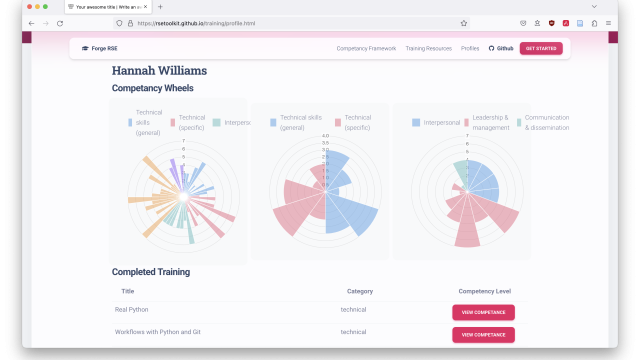
rse-forge-screenshot

RSE Capabilities Framework

Our team includes a number of research software engineers (RSEs) who combine technical expertise with a deep knowledge of research practices and the unique complexities of humanities data.  The RSE role is increasingly recognised as a vital one in research delivery, and we actively support the development of humanities-specific RSE training and career pathways. As part of this work, we contributed to a panel at the annual UK–Ireland Digital Humanities Association conference titled 'Giving a Digital Humanities Voice to the Research Technical Professionals Skills Framework'. The panel was organised by Phil Reed (University of Manchester), an SSI Fellow currently developing the application of the DIRECT Framework to Digital Humanities.

distorted lake and trees Lone Thomasky & Bits&Bäume / https://betterimagesofai.org / https://creativecommons.org/licenses/by/4.0/

RSE Summer School

As co-organisers of the UK's DH RSE Summer School, which is aimed at postgraduate students, researchers and other professionals in Digital Humanities and allied sectors who wish to learn more about careers and best practices in Research Software Engineering, we contributed a day of training focused on environmental sustainability. Sustainability is key to good software engineering —not just in planning, maintaining and sharing software, but also in developing environmentally responsible computing practices that reduce the impact of digital research on the world. This event was organised by CDCS, King’s Digital Lab, Cambridge Digital Humanities and the DISKAH Network, with funding from Strategic Technical Platform for University Technical Professionals (STEP-UP) and the UK Society of Research Software Engineering.