spirit case

Training


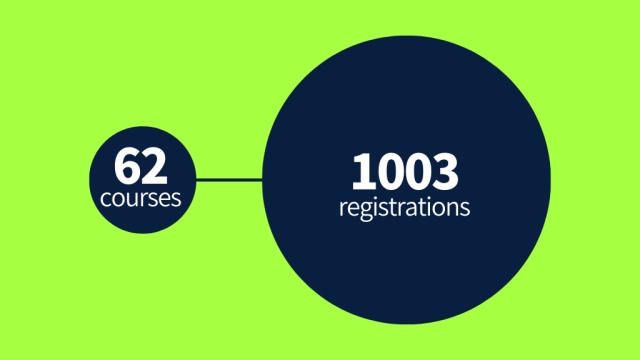
Our digital research methods training programme continued at pace this year, serving more researchers than ever: for the first time, we recorded more than 1,000 sign-ups over our 62 courses. Reflecting the brilliant diversity of our research community, we offered courses on subjects ranging from topic modelling, to statistics, to photogrammetry. Our talented team of Training Fellows also helped us to deliver another CDCS Summer School, this year with two streams and over 40 attendees. We've also improved the accessibility of our online materials with a new GitHub interface, work that we will continue to build on in the coming year. 

62 courses  with 1003 registrations

Our Training Programme


Demand for CDCS training opportunities grows year after year, with 1,003 staff and students signing up for over 60 courses in academic year 23/24. Courses ranged from structured and unstructured data analysis, introduction to programming, GIS, to digital drawing and 3D data, and were designed and facilitated by our Training Fellows as well as colleagues from EDINA, Library, LLC, University Collections and uCreate Studio.

Training Breakdown: Our Core Topics

  • Digitised documents & text analysis: training on the processes of working with unstructured data from the extraction of information from digitised documents to advance language models.
  • Intro to programming: introductory classes that help attendees to familiarise themselves with the main programming languages.
  • Data wrangling & data visualisation: training on the practicalities of exploring datasets from cleaning messy data to producing effective visualisations.
  • Structured data analysis: from descriptive statistics to regression and null-hypothesis testing.
  • Geographical data: training on working with spatial data from introducing GIS to bridging data analysis and geographical data.
  • Digital drawing & 3D data: from technical drawing in AutoCAD to acquiring, processing and printing 3D data.
  • Good practices of digital research: exploring the practicalities of doing digital research from working with pre-prints to data ethics. 
Training Breakdown number of events

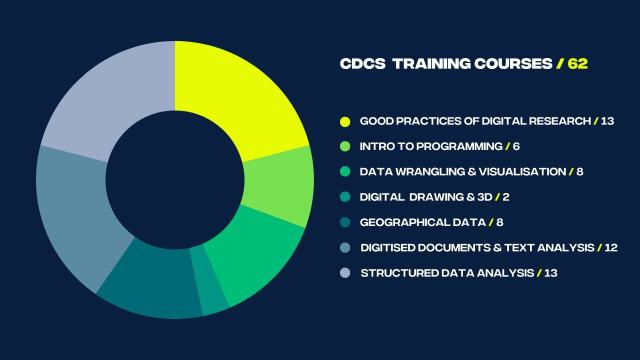
We ran 62 courses and workshops this year, which can be grouped as follows: 

  • 13 focused on good practices of digital research
  • 6 on introduction to programming (with a focus on Python and R)
  • 8 on data wrangling and data visualisation
  • 2 on digital drawing and 3D
  • 8 on geographical data
  • 12 on digitised documents and text analysis
  • 13 on structured data analysis.
Training Breakdown Sign ups

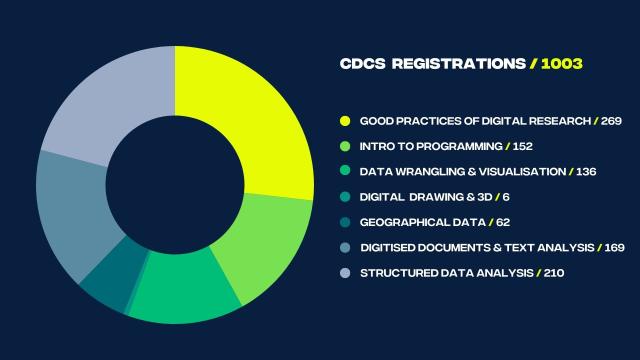
So which topics were the most popular? 269 people attended courses and workshops on good practices of digital research, which cover topics such as working collaboratively with version control and the legal and ethical issues of web scraping. More than 200 people signed up for courses on structured data analysis with a focus on statistics. Data wrangling and data visualisation attracted more than 130 attendees. Beginners' coding courses attracted 152, while over 169 people wanted to learn about working with textual documents. Finally, 62 people signed up for geographical data courses, and 6  signed up for courses on drawing and 3D data.

This was a clear, lucid and brilliantly taught introduction. As a complete novice to GitHub, I was relieved that the course started from the absolute basics, introduced each concept and use clearly, and enabled me to try out using GitHub myself for a couple of very simple version control processes. The teaching was really excellent, both in terms of formal presentation and less formal individual help with problems when they arose.

Participant, Training Programme 2023-24

CDCS Summer School 2024

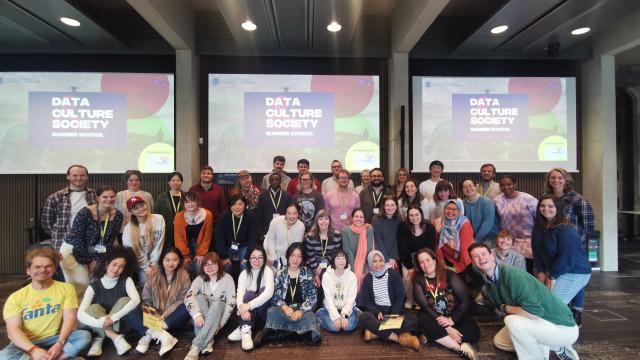
In June, we hosted our ever-popular Summer School, in which two simultaneously run streams catered to researchers with different skill levels. The Gentle Introduction to Coding for Humanities and Social Sciences course was designed for complete beginners to coding and data analysis. Through lectures and exercises, attendees of this stream learnt how to code in Python, starting from core concepts such as variables and loops through to coding live data visualisations. By the end of the course, attendees understood how to bridge the gap between humans and computers, and how to apply the skills they have learnt to their own data analysis and research. 

The Data and Analysis in the Wild course was designed to help attendees with prior coding experience better understand how data and text analysis projects are performed in a research environment. Starting from identifying a series of research questions connected to this year’s core topic, life in Scotland from the past to the present, attendees explored techniques for analysing a variety of real-world datasets. They learnt how computational methods can be used to obtain, clean and analyse structured and unstructured datasets in R to answer their research questions. Topics covered in this course included web scraping, text analysis, sentiment analysis, data wrangling, statistics and data visualisation. 
 

sculptures with github logo on top

Sharing our materials

Since we created our GitHub page in 2021, our collection of materials has grown to 77 repositories contributed by 33 people. To encourage people to use these materials, we have developed a dedicated navigation page designed to offer a user-friendly interface that supports both title-based and thematic searches across our repositories. Additionally, we are actively curating a selection of self-contained tutorials on our GitHub, ensuring that users can easily find and engage with the content that best meets their needs.

Our Training Fellows

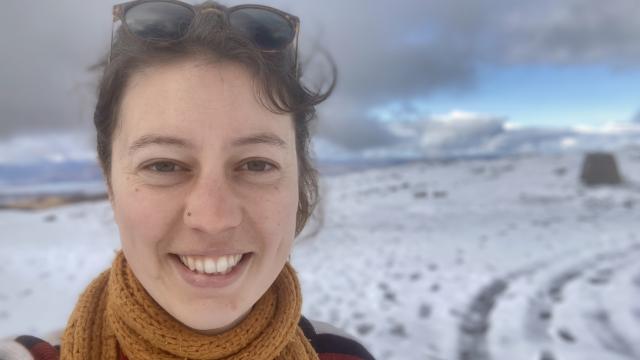
Aislinn Keogh

Aislinn Keogh

Aislinn is a PhD student in the Centre for Language Evolution. Her research combines behavioural experiments and agent-based modelling to investigate the role of language production biases in the emergence of linguistic structure. She is proficient in Python, R and JavaScript and is passionate about the use of simulation-based techniques for experimental design and data analysis.

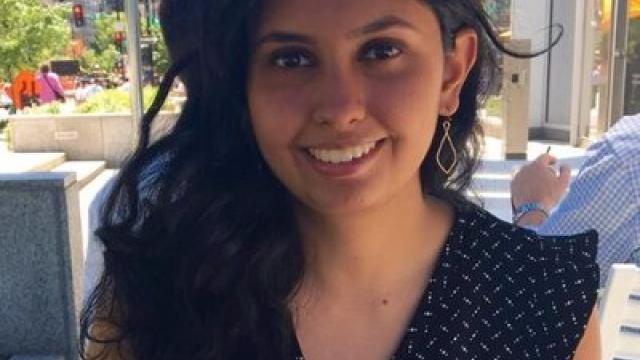
Image of Bhargavi Ganesh

Bhargavi Ganesh

Bhargavi is a PhD student at the University of Edinburgh, doing interdisciplinary research at the intersection of philosophy, computer science and public policy. She is affiliated with the Center for Technomoral Futures and the UKRI Research Node on Trustworthy Autonomous Systems Governance and Regulation. She has worked at non-profit research organizations and government institutions, where she studied the impact of housing policies on marginalized groups. In her doctoral research, Bhargavi is developing frameworks to guide the governance and regulation of autonomous systems and decision-making algorithms in various fields including health, robotics and finance. 

Brian Tsz Ho Wong

Brian Tsz Ho Wong

Brian Tsz Ho Wong is a PhD candidate (East Asian Studies) in the School of Literatures, Languages & Cultures. His research explores the networks of capital and power elites in the wartime Japanese Empire, and the use of private capital to fuel imperial ambitions. He is passionate about using digital tools (Gephi, QGIS and Google Earth) in his research. At CDCS, he is excited to teach and support the use of Gephi in humanities and interdisciplinary studies.

Chris Oldnell

Chris Oldnall

Chris is a PhD mathematics researcher with the MAC-MIGS Centre of Doctoral Training, who is affiliated with the Institute of Genetics and Cancer. His work is interdisciplinary and involves combining causal inference with genomics. He loves teaching individuals on how to get the most out of ‘big data’ by using data analysis techniques appropriately and accurately, and most importantly how to implement these in Python and R.

Image of Fang Jackson-Yang

Fang Jackson-Yang

Fang Jackson-Yang is based in the School of Philosophy, Psychology, and Language Sciences. Fang researches how people communicate prominent information in transitive events (e.g., “Jerry kicked the oil lamp”). She uses eye-tracking techniques to investigate when and how listeners make predictions of the endpoints of such events (e.g., the lamp fell on the floor). She also uses laboratory and digital corpus data to investigate how speakers use various sentence structures and other linguistic means to describe such events in different settings and what factors influence their choices.

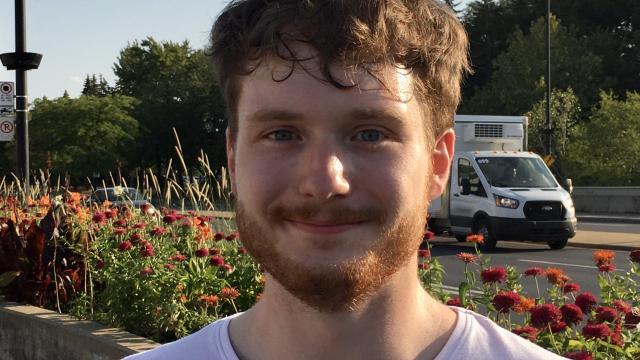
Image of Jame Besse

James Besse

James Besse is a PhD student in Science, Technology and Innovation Studies. James’ research is on the implementation of e-ID systems, specifically looking at the EU Settlement Scheme. He uses text mining alongside social surveys and interviews to understand user experience with the EUSS. Broadly, James is interested in the social impacts of new technologies, and how digital methods can help to understand them. He is happy to provide assistance with R, statistics, web scraping, data visualisation and research design.

Ki Tong

Ki Tong

Ki is a PhD candidate at the Advanced Care Research Centre studying ways to enhance greenspace accessibility for older adults. She is a landscape architect with professional experience delivering construction projects and landscape assessments. Besides an interest in using QGIS and ArcGIS for geospatial visualisation and analysis, she expanded her exploration with aggregating geospatial data and performing further analysis with R to study the correlation between environmental variables and urban density. 

Martin Disley

Martin Disley

Martin Disley is a practice-led design researcher based at the Institute for Design Informatics at the University of Edinburgh. His critical engineering studio practice blends artistic inquiry and investigative computing, producing outputs in software, film, installation, and text. His PhD research explores adversarial design and investigative aesthetics as Research through Design methods for explainability and interpretability of generative computer vision.

Prior to pursuing his PhD, he worked as a software developer for a music technology startup and as a research engineer at the University of Edinburgh.

Rhys Davies

Rhys Davies

Rhys is based at the School of Health in Social Sciences.

Rhys is a psychologist researching adaptive behaviours and mental health in elite sports. His research makes use of statistical modelling with survey data, particularly investigating interactions to determine how context shapes the efficacy of “adaptive” behaviours. His preferred coding language is R, and he is passionate about using data visualisation techniques to communicate and simplify research findings.

Sarah Schöttler

Sarah Schöttler

Sarah Schöttler is a PhD candidate at the VisHub lab in the School of Informatics. Her research explores responsive visualization with a focus on geographic data and visualization. She is active in the visualization community and has previously worked as a visualisation and map developer for clients such as the PeaceRep consortium at the Edinburgh Law School. At CDCS, she is excited to teach and offer support with data visualization and mapping, web development, and general programming skills.

Sarah Van Eyndhoven

Sarah van Eyndhoven

Sarah van Eyndhoven is based within the school of Philosophy, Psychology and Language Sciences, where she has recently finished her PhD in historical sociolinguistics. Her project explored the use of Scots language features in eighteenth century Scottish correspondence, sourced from the National Library of Scotland. Combining Handwritten Text Recognition models to automatically transcribe a large collection of written letters, with corpus software and statistical modelling, Sarah was able to uncover the influence of different social and political factors in predicting Scots usage in an underexplored area of historical Scots scholarship.

Xan Cochran

Xan Cochran

Xan Cochran (they/them) is a Research Masters’ student in Informatics, with supervisors in Informatics and Philosophy. Their research concerns the metaphysics of ‘levels’ in scientific discourses, and combines philosophical analysis with the computational modelling of epistemic communities. They hold degrees in English Literature and Developmental Linguistics, and have for the last decade been working as a tutor for the University, having tutored in the Schools of Informatics; Philosophy, Psychology, and Language Sciences; Social and Political Sciences; Biological Sciences; Design; Music; Physics and Astronomy; Mathematics; Economics; and Geosciences. In their spare moments, they paint and write science fiction.

It was one of the best weeks I have had since I started my PhD, and has inspired so many ideas and opportunities for my own research.  ​

Participant, CDCS Summer School 2024