fairy cakes

RESEARCH PROJECTS


We've been delighted to be able to support a wide range of projects again this year.  As well as supporting a significant new grant, which explores the potential of large scale cultural analytics, we've enabled a few research projects to take key steps forward and offered small scale funding to a number of PhD students through an open call. We've also continued to focus energy and resources on facilitating research in text and data mining and enabling the use of high performance computing, both areas of strategic focus for CDCS.

abstract data visualisation with colours and numbers

Towards Large-scale Cultural Analytics in the Arts and Humanities


With funding from the UK’s Arts and Humanities Research Council and in partnership with Data Thistle, CDCS Director Melissa Terras is leading a project that explores how data generated by the tens of thousands of cultural events that happen across the UK every week - from theatre to comedy, and festivals to exhibitions - can be made accessible to researchers interested in the UK’s cultural and creative economy. The CDCS Tourism, Technology & Data cluster is one of several partners on this project, which involves an interdisciplinary team from the universities of Edinburgh and St Andrews.

Visit the project website

PhD Call Funding 2021

Anna-Viktoria Vittinghoff

Anna was able to purchase an OCR software licence to assist her project 'Yonezu Tomoko, ūman ribu and the disabled movement - Radical intersectional feminism in Japan in the 1970s'.

Chad Lance Hemady

We helped Chad get the right analysis tools for his project 'Intergenerational Transmission of Adversity using the Evidence for Better Lives Study'.

Lucie Woellenstein

Our support enabled Lucie to access the National Data Safe Haven for her work 'Using Predictive Modelling to Evaluate the Effectiveness of Homelessness Prevention Tools for Those Experiencing Multiple Exclusion Homelessness in Scotland'. 

Paul Abbott

Paul was able to purchase specialist software for his Creative Music PhD.

Jiang Yuhan

Our help enabled Jiang to use Atlas.ti software for fieldwork for her work on The Jazz Field in China.

image of woman on screen

It's all about the feelings...

We were delighted to be able to support a new performance project which looks at AI and emotion and innovative digital strategies for performance distribution. Sentiment recognition systems use face recognition to map facial expressions, with natural language processing and biometrics, to systematically identify users' affective states, i.e. emotion. However, AI systems are not without bias and problematic standardisation, which potentially reinforce privileges and inequalities, racism, sexism, ageism and western cultural bias. In 'It's all about the feelings...' artist Beverley Hood and actor Pauline Goldsmith playfully interrogated how AI maps actors’ emotive expression within different acting techniques, unpicking complex issues about AI’s reductive methods of standardisation, categorisation and bias in amplifying privileges and inequalities around race, sex, gender, age and ability. Funding from CDCS will be used to develop new web materials as an online hub for the project.

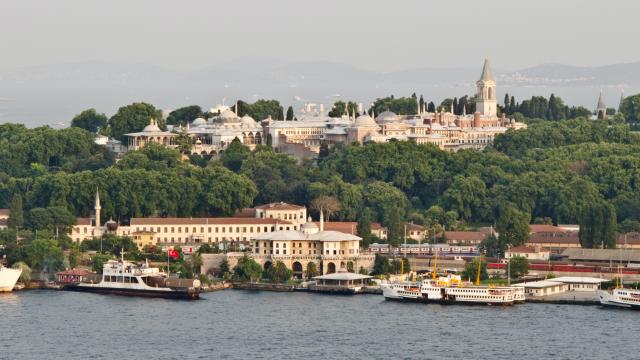
Topkapi Palace, Istanbul

Revealing the Waters below the Sultan’s palace

Led by Professor James Crow, this project saw PhD student Stefano Bordoni build a GIS based 3D digital terrain model of the Topkapı Saray in Istanbul. Since the late 15th Century this was the palace of the Ottoman Sultans and within its four courts are the remains of the Byzantine First Hill and a unique sequence of large cisterns, which have the potential to shed light on the functioning of the Byzantine and Ottoman water supply. The model will make it possible to create new visualisations of the famous palace and its subsurface heritage for future public display and publications, revealing a new unrecognised aspect of the city’s long-term history and insights into past technological achievements. The project is a collaboration between the University of Edinburgh, Northumberland University, the Technical University of Istanbul and the British Institute at Ankara.

The funding we got allowed me to manage archaeological data from previous research on the water system of Istanbul, merging them together in a GIS platform. This contribution has been essential for the team in order to visualise, analyse and comprehend Constantinople's water network and its complex ramifications.

- Stefano Bordoni, PhD in the School of History, Classics and Archaeology

music mixing decks

Music streaming as global cultural diffusion

We've been pleased to assist this project, led by Tod Van Gunten, develop from an idea shared at one of our Stakeholder forums to a pilot project funded by Creative Informatics. The project uses daily global rankings data from the music platform Spotify to analyse patterns of cultural diffusion in the music arena. As of late 2021, Spotify was available in 69 countries and reported having more than 400 million users. Daily rankings data (the top 200 most-streamed songs) are available for each country since 2017, enabling Tod and his team to examine patterns of global cultural diffusion, that is, the spread of cultural objects (songs) around the world.


Growing our TEXT MINING capacity
 

mashup with flask

As part of our second Text Mining Lab in the summer of 2021, we supported six researchers to develop questions based on their interests, and then to use defoe to run queries against a variety of datasets. An exciting range of research questions emerged, ranging from testing conformity of company constitutional documents, to how the economy has been framed in newspaper discourse, to shifts in public perception of Kashmir, to the reception of Latin poetry in British publications. Researchers were supported in exploring these questions by our colleagues at the Edinburgh Parallel Computing Centre. This year we have also been trialling the use of ProQuest's TDM Studio, a workspace in which researchers have been able to explore and analyse ProQuest data. 

We're also thrilled to have recruited a new team member this year: Dr Jessica Witte will take up an EFI Postdoctoral Fellowship in Text Mining in June and, alongside her own project, she has a remit to work with CDCS to help others get started with these exciting methods. To complement this support, we've also been looking at how we can increase the range of materials that researchers in the arts and humanities can access for computational analysis. We've purchased a large set of newspaper data from ProQuest, including titles from Britain and the United States published over the course of the Nineteenth and early Twentieth Centuries. We've also sponsored digitisation of more of the University's collections in partnership with colleagues in Library and University Collections. Together we're aiming to build up an impressive collection of historical digitised materials which could underpin a huge range of research topics. 

 

I was privileged to have a project selected for the sandbox on text mining last summer. The experience of working on a truly interdisciplinary project was amazing. This kind of initiative is so valuable to us early career researchers, as it allows us to explore methodological matters and expand our network of interdisciplinary collaborators.

- Dr Jonny Hardman, School of Law