fairy cakes

TRAINING


This year saw our training team triple in size as our two returning Training Fellows were joined by six new colleagues from across the College, each bringing their specialisms and expertise to the programme. We were delighted to be able to broaden the range of topics offered across our programme as a result, and despite having to continue to work fully online, this year's programme featured a wide array of skills and methods courses in a number of different formats.  We also introduced a new Data Surgery, where researchers can book time to discuss their own projects with our Training Fellows. Over the summer we delivered our first ever CDCS Summer School, focused on text and data analysis. The enthusiastic feedback we received prompted us to plan a second Summer School this coming year, which we are looking forward to hosting in June 2022.


63 courses 685 registrations

Our programme

We continue to have strong attendance across our courses with over 600 staff and students upskilling with us this year and participating in over 60 courses on topics ranging from structured and unstructured data analysis, programming, and GIS, to digital drawing and 3D data. We were able to achieve this by drawing on the expertise of our Training Fellows and colleagues from EDINA, Library, University Collections, and UCreate Studio. 

What's new?

Keyboard Pathways

New Training Pathways

We are committed to helping researchers orient themselves and learn new methods, that's why we have developed even more Training Pathways.

This year's additions cover the topics of Statistical Analysis and Text Analysis. Two new pathways on Managing Digitised Documents and Analysing Geographical Data are currently under development.

Statistics Mashup

Workshop Series

We kicked off the second semester with a new type of training: the workshop series. These are interconnected training events that focus on different aspects of the same topic. Attendees can book all of the associated workshops or just individual workshops.

The first four series covered: Copyright, Recording 3D data, Digitised Documents and Statistics. 


Florence Meshup

Data Surgeries

The Data Surgeries meetings are a new initiative this year. These one-to-one meetings with our training fellows can be booked by CAHSS researchers looking for help with the application of data and digital-driven techniques. After attending training, researchers can sometimes struggle to apply their learning to real-world data: this format provides a chance to get advice on how to process data, how to troubleshoot issues and how to find further information and training options.

Training by Topic

63 courses breakdown

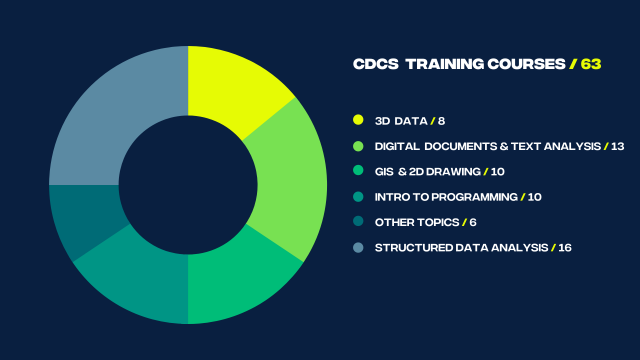
We ran 63 courses this year, which can be loosely grouped by topic: 16 focused on structured data analysis, 13 on digital documents or text analysis, 10 were for those beginning to code, another 10 focused on drawing and mapping, and 8 focused on 3D data.

training registrations by topic

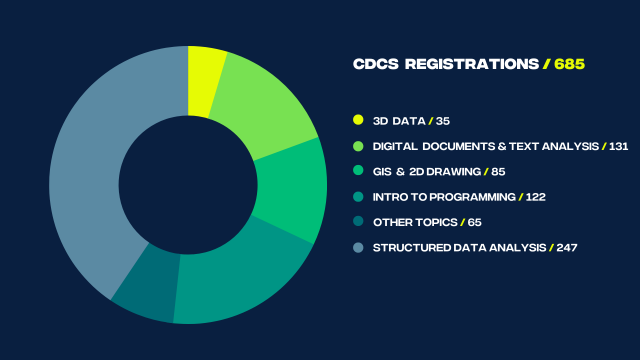
So which topics were the most popular? Structured data analysis attracted almost 250 people. Beginners coding courses attracted 122, while over 130 people wanted to learn about working with textual documents. Drawing and Mapping attracted 85 registrations, while 35 people signed up for courses on 3D data.

Online Training Materials

Like everyone else, we've been working online for almost two years now. While we're looking forward to getting back to in-person workshops, we're keen to keep building up and working with the web-based tutorials and materials that we have created and have access to. We share what we have created in our Github repository, and we're proud to say that our collaboration with the excellent Programming Historian initiative continues via our 'Silent Disco' format.


CDCS on Github

Visit the Programming Historian


image of lighthouse

CDCS text & data analysis summer school 2021

We held our first summer school last June. Delivered online and with support from the Scottish Graduate School for Social Sciences, it was attended by academic researchers and professionals from across Scotland. Participants were able to choose between ten blocks of teaching, tailoring their own pathway, while also being given a choice between R and Python as coding languages.  It was funded by the Data-Driven Innovation Initiative as part of their ‘Building Back Better’ open funding programme, and supported by the Scottish Funding Council Covid-19 Recovery funding to the University of Edinburgh.

Find out more

This was by far the most relevant, well-organised and interesting training that I have ever attended.

- Participant: Text & Data Analysis Summer School 2021

Our Training Fellows

James Besse

James Besse

James is a PhD student in Science, Technology and Innovation Studies. His research concerns the implementation of e-ID systems, specifically looking at the EU Settlement Scheme. He uses text mining alongside social surveys and interviews to understand user experience with the EUSS.


Stefano Bordoni

Stefano Bordoni

Stefano has recently completed a PhD in Architectural Archaeology at the School of History, Classics and Archaeology. In his thesis, he turned the building materials used in medieval Umbria into quantitative data, in order to identify patterns. Through this, he is knowledgeable in photogrammetric surveying, AutoCAD vector drawing, QGIS geoprocessing, RStudio data management and visualisation.


Lucy Havens

Lucy Havens

Lucy is a PhD student based in the School of Informatics, and she researches bias in cultural heritage metadata. Using a collection of case studies within cultural heritage collections (such as the Archives at the University of Edinburgh), she combines natural language processing and data visualisation technologies to identify and classify the bias present in the language of cultural heritage catalogues.


Fang J-Y

Fang Jackson-Yang

Fang is a PhD student at the School of Philosophy, Psychology, and Language Sciences. Her project investigates how speakers encode prominent information in simulated conversations and how listeners predict upcoming utterances in comprehension. She works with both laboratory and corpus data. She conducts data analyses in R using multivariate statistical tools such as mixed-effects models.

Andrew McLean

Andrew McLean

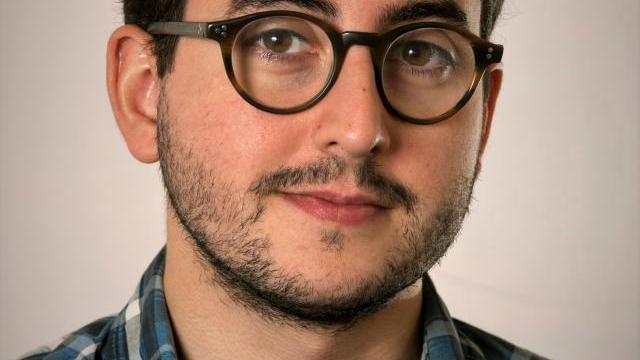
Andrew is finishing his PhD at the School of History, Classics and Archaeology. As an archaeologist with research interests currently focused on the economy of the Roman Adriatic, his methodological approaches include GIS and statistical analysis, particularly expanding on traditional Least Cost Path (LCP) analysis by using circuit theory to model maritime movement.

Enric Martorell

Enric Martorell Toledano

Enric is a PhD researcher at the School of Economics, focusing on macroeconomics and inequality. His research is based on quantitative heterogeneous agent models estimated using cross-sectional and longitudinal household-level data, which he uses in order to identify the effect of different macroeconomic policies on consumption, wealth, and income inequality.

Daniel Wheedon

Daniel Wheeldon

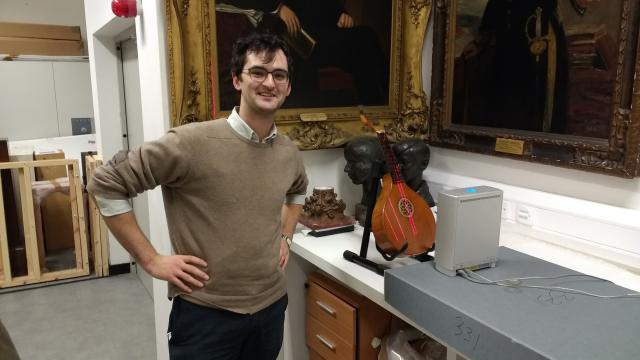
Daniel holds a PhD degree in musicology. He has worked with museums and private collections in the UK, Germany, and USA, using traditional and digital technologies to extract information from original art objects. As a Chester Dale fellow at the Metropolitan Museum of Art (NY), he also took part in a project investigating the efficacy of photogrammetry in studying museum objects.

The instructor was very knowledgeable and enthusiastic, and I particularly appreciated the course materials which provided a lot of detail, and excellent explanation of the code.

- Participant: Mixed Effect Modelling with R