Background image with trees

Training


Our training was as popular as ever this year, with hundreds of researchers continuing to benefit from a range of courses, including new offerings focused on incorporating artificial intelligence and large language models into research practice.  As always, all our courses were developed and delivered by our talented team of Training Fellows, who join us from across the University bringing a diverse mix of skills and research experience.
Training number for 24-25

Our Training 


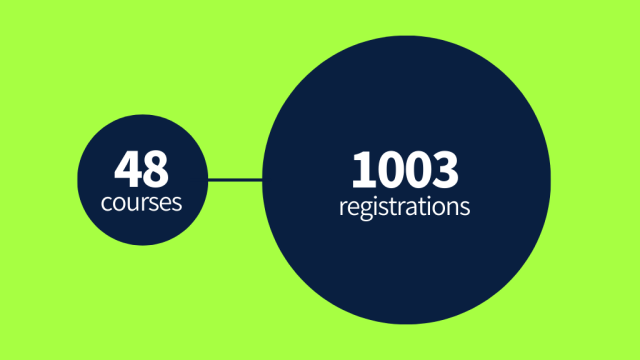
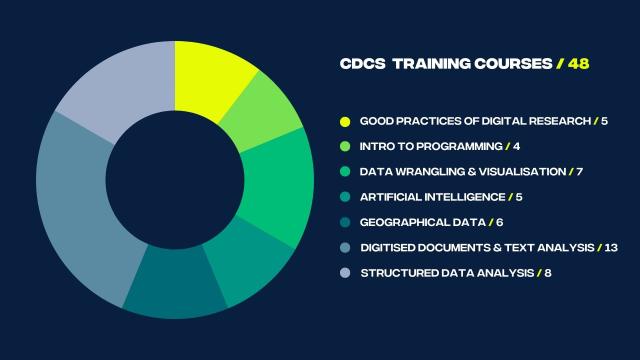
This year, our training offer was streamlined to a core programme of 48 courses and workshops, which attracted 1003 registrations over two semesters. Courses ranged from structured and unstructured data analysis to GIS and, for the first time, the use of AI and LLMs in research. 

Core Programme

  • Digitised documents & text analysis: Training introduced methods for working with unstructured and digitised texts, covering topics like sentiment analysis, topic modelling with BERT, word embeddings, named entity recognition and network analysis with Gephi. These sessions supported researchers in extracting meaningful insights from large-scale text collections and archival materials.
  • Intro to programming for researchers: Courses in R and Python provided accessible entry points for those new to coding, focusing on building confidence in using scripts, automating tasks and handling data for research.
  • Data wrangling & data visualisation: Participants explored pipelines for cleaning, manipulating and presenting data as well as best practices for creating clear, effective and reproducible visual outputs.
  • Structured data analysis: The programme offered both introductory and advanced statistics, including linear modelling, Bayesian methods, causal inference, regression, mixed effects modelling and machine learning. These provided a foundation for analysing quantitative datasets.
  • Geographical data: Training in QGIS and R supported skills in geospatial analysis, geocoding and spatial dynamics. Sessions demonstrated how to map, interpret and integrate spatial data into broader research contexts.
  • Artificial Intelligence: Sessions introduced both the possibilities and limitations of generative AI and large language models, alongside hands-on activities such as prompt engineering and using local LLM models. The emphasis was on critically applying AI in research.
  • Good practices of digital research: The programme reinforced sustainable and ethical research practices, from version control with GitHub and R Markdown for reproducibility, to legal considerations in web scraping and collaborative methods such as crowdsourcing data.
Training breakdown24-25: CDCS Training courses / 48 Good Practices of Digital Research / 5 Intro to programming / 4 Data Wrangling & Visualisation / 7 Artificial Intelligence / 5 Geographical Data / 6 Digitised Documents & Text Analysis / 13 structured data analysis / 8

We delivered 48 courses and workshops this year, including 13 on digitisation & text analysis, 8 on data analysis and 7 on data wrangling and visualisation. 

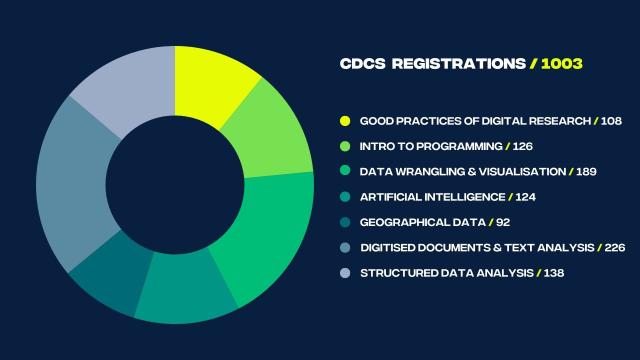
Breakout of sign ups by topic for the 24-25 year: CDCS Registrations/ 1003 Good Practices of Digital Research / 108 Intro to programming / 126 Data Wrangling & Visualisation / 189 Artificial Intelligence / 124 Geographical Data / 92 Digitised Documents & Text Analysis / 226 CDCS Registrations / 1003 structured data analysis / 138

Our most popular topics were digitised documents, text analysis, data wrangling and visualisation. Artificial intelligence was also popular, attracting 124 participants, while 108 attended sessions on good practices of digital research. 

"One aspect of this course that I thought was particularly well done was the hands-on approach. Rather than spending too much time on theory, we were encouraged to get involved and start practising straight away. I found this to be a highly effective way of learning, as it allowed us to engage with the material actively. Through the exercises, I inevitably picked up new knowledge, sometimes even without realising it at first."

- Participant, Training Programme 2024-25

Training Image

Sharing is Caring


Our GitHub page is now hosting 91 repositories contributed by 44 people. All of our repositories are covered by a CC-BY-NC 4.0 licence to encourage reusability. These repositories can be easily navigated through both title-based and thematic searches. Additionally, this page now features three comprehensive tutorials focused on best practices in digital research and structured data analysis, with more resources forthcoming.

Our Training Fellows

Aislinn Keogh

Aislinn Keogh

Aislinn is a PhD student in the Centre for Language Evolution. Her research combines behavioural experiments and agent-based modelling to investigate the role of language production biases in the emergence of linguistic structure. She is proficient in Python, R and JavaScript and is passionate about the use of simulation-based techniques for experimental design and data analysis.

Brian Tsz Ho Wong

Brian Tsz Ho Wong

Brian Tsz Ho Wong is a PhD candidate (East Asian Studies) in the School of Literatures, Languages & Cultures. His research explores the networks of capital and power elites in the wartime Japanese Empire, and the use of private capital to fuel imperial ambitions. He is passionate about using digital tools (Gephi, QGIS and Google Earth) in his research. At CDCS, he is excited to teach and support the use of Gephi in humanities and interdisciplinary studies.

Chris Oldnell

Chris Oldnall

Chris is a PhD mathematics researcher with the MAC-MIGS Centre of Doctoral Training, who is affiliated with the Institute of Genetics and Cancer. His work is interdisciplinary and involves combining causal inference with genomics. He loves teaching individuals on how to get the most out of ‘big data’ by using analysis techniques appropriately and accurately, and most importantly how to implement these in Python and R.

Image of Fang Jackson-Yang

Fang Jackson-Yang

Fang Jackson-Yang is based in the School of Philosophy, Psychology and Language Sciences. Fang researches how people communicate prominent information in transitive events. She uses eye-tracking techniques to investigate when and how listeners make predictions of the endpoints of such events. She also uses laboratory and digital corpus data to investigate how speakers use various sentence structures and other linguistic means to describe such events in different settings and what factors influence their choices.

Ki Tong

Ki Tong

Ki is a PhD candidate at the Advanced Care Research Centre studying ways to enhance greenspace accessibility for older adults. She is a landscape architect with professional experience delivering construction projects and landscape assessments. Besides an interest in using QGIS and ArcGIS for geospatial visualisation and analysis, she expanded her exploration with aggregating geospatial data and performing further analysis with R to study the correlation between environmental variables and urban density.

Martin Disley

Martin Disley

Martin Disley is a practice-led design researcher based at the Institute for Design Informatics at the University of Edinburgh. His critical engineering studio practice blends artistic inquiry and investigative computing, producing outputs in software, film, installation and text. His PhD research explores adversarial design and investigative aesthetics as Research through Design methods for explainability and interpretability of generative computer vision.

Rhys Davies

Rhys Davies

Rhys is a psychologist based at the School of Health in Social Sciences where he is researching adaptive behaviours and mental health in elite sports. His research makes use of statistical modelling with survey data, particularly investigating interactions to determine how context shapes the efficacy of “adaptive” behaviours. His preferred coding language is R, and he is passionate about using data visualisation techniques to communicate and simplify research findings.

Sarah Schöttler

Sarah Schöttler

Sarah Schöttler is a PhD candidate at the VisHub lab in the School of Informatics. Her research explores responsive visualization with a focus on geographic data and visualization. She is active in the visualization community and has previously worked as a visualisation and map developer for clients such as the PeaceRep consortium at the Edinburgh Law School. At CDCS, she is excited to teach and offer support with data visualization and mapping, web development and general programming skills.

Xan Cochran

Xan Cochran

Xan Cochran (they/them) is a Research Masters’ student in Informatics, with supervisors in Informatics and Philosophy. Their research concerns the metaphysics of ‘levels’ in scientific discourses, and combines philosophical analysis with the computational modelling of epistemic communities. They hold degrees in English Literature and Developmental Linguistics, and have for the last decade been working as a tutor in schools across the University. 

"The content was so so interesting and I did more practical work (and of a higher depth and complexity) than I have with pretty any other training course, which is a great way to learn. It was challenging (in a good way) and manageable with my current skills."

- Participant, Training Programme 2024-25