
split faces with computer mouse print over

TRAINING


Our training programme has been a real focus this year with the arrival in September of our new Digital Research Skills Training Manager, Lucia Michielin. Along with our CDCS Training Fellows, Lucia delivered an expanded programme of live training events in 20/21 and has been exploring ways to create and signpost to more online training materials. The training pages on our refreshed website have been developed to include information about where to find online training, and where to start with developing skills required for different methods. This year also sees us preparing for our first CDCS Summer School, and contributing to another summer school run by the Alan Turing Institute, which both point forward to an exciting future full of potential. 
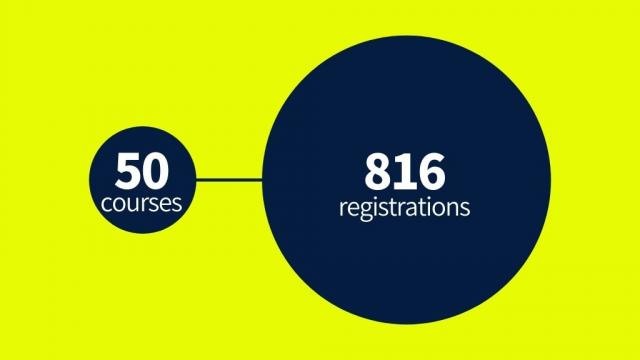
50 courses and 816 registrations

Our programme 

This year's programme drew on the skills of trainers from across the College and University. As well as our fellows, introduced below, we enabled our community to benefit from the expertise of colleagues in EDINA, Library and University Collections and the Software Sustainability Institute. We continue to offer Carpentries workshops, and to maximise the value of online resources such as those provided by the Programming Historian. We're also capturing some of our courses and making them available online through a GitHub repository. 

What's new?

Keyboard Pathways

Training Pathways

We have developed new Training Pathways that we hope will help researchers orient themselves and get started with learning new methods. So far, we have pathways for: Data Visualisation; Statistical Analysis; Managing Digitised Documents; and Text Analysis, and we plan to add more in the coming months.  

mash up of werewolf

Method of the Month

Another initiative to help those starting out, the Digital Method of the Month sessions are a chance to discuss practicalities and prerequisites for learning and implementing new methods. So far we've held sessions on 3D scanning, GIS, data visualisation, text analysis, databases and machine learning. 

Headphones, laptop, CDCS logo

Silent Discos

We're delighted to be an Institutional Partner of the Programming Historian, and this year we have successfully used their training materials in a new  'silent disco' format: participants work through online tutorials in a cohort with some support from one of our trainers.

"I liked the video introduction and knowing that someone is on-hand if problems arise... They covered skills that have been on my to-do list for a while."


- Participant, Silent Disco: Getting started with Markdown

Profile picture of Lucia Michielin

New Training Manager: Dr Lucia Michielin

Eight months ago, we welcomed Lucia to the team to develop our training offer. Having been awarded a PhD in Classics from the University of Edinburgh in 2019, Lucia’s research background in the Digital Humanities has equipped her with a great deal of experience in applying digital methods to research projects, and she has considerable experience of designing and delivering training courses focused on data skills and digital research methods. It has been wonderful to watch Lucia apply her specialist technical expertise and knowledge to developing a digital research methods training programme, and we're excited to see how this aspect of our work develops during her time with us.


"Clear focus on the topic, very efficiently and effectively presented - targeted exactly what I wanted to know"

- Participant, Spatial Data Visualisation

Training Fellows 2020-2021

Esgrid Sikahall

Esgrid

Esgrid Sikahall Urizar has worked as a mathematics lecturer in Guatemala (including Numerical Analysis) before moving to the UK to study philosophy, religion and science. He has worked on Python, Matlab and as a web programmer using HTML, PHP, CSS, and MySQL. His current research is on philosophical hermeneutics (Hans-Georg Gadamer) and the implementation of historiographical works on science and religion in wider cultural spaces and discourses.

Email: esgrid.sikahall@ed.ac.uk

Lucy Havens

Lucy Havens

Lucy Havens is based in the School of Informatics. Lucy is researching bias in cultural heritage metadata. Combining natural language processing and data visualization technologies, she seeks to identify and classify bias present in the language of cultural heritage catalogues. She conducts this research through case studies with cultural heritage collections, such as the archives at the University of Edinburgh.

Email: lucy.havens@ed.ac.uk 

Andrew McLean

Andrew McLean

Andrew McLean is based in the School of History, Classics and Archaeology. Andrew is an archaeologist with research interests currently focused on the economy of the Roman Adriatic. His methodological approaches include GIS and statistical analysis, particularly expanding on traditional Least Cost Path (LCP) analysis by using circuit theory to model maritime movement. Through this, he is familiar with QGIS, R, Circuitscape, shell scripting and programming languages such as Julia and Python.

Email: Andrew.McLean@ed.ac.uk

"The course has enthused me to the extent I definitely want to learn more to become more proficient... this has been a really excellent course. Thanks to CDCS and Esgrid, the tutor, for making it so helpful and engaging."


- Participant, Introduction to Programming in Python

Lighthouse over old etching of Leith docks

In development: CDCS Summer School

In June, we'll be holding our first Data and Text Analysis Summer School, focused on using Python and R for data and text analysis. The school is funded by the Data-Driven Innovation initiative as part of their ‘Building Back Better’ open funding programme, and will be primarily targeted at researchers from higher education institutions from Edinburgh City and its regions. The summer school is also open to professionals based in Scotland who are interested in upskilling and implementing digital methods in their everyday work. It provides CDCS with an opportunity to explore the intensive course format and consider whether we can usefully adopt the model going forwards: we're looking forward to reporting back on this venture next year.