
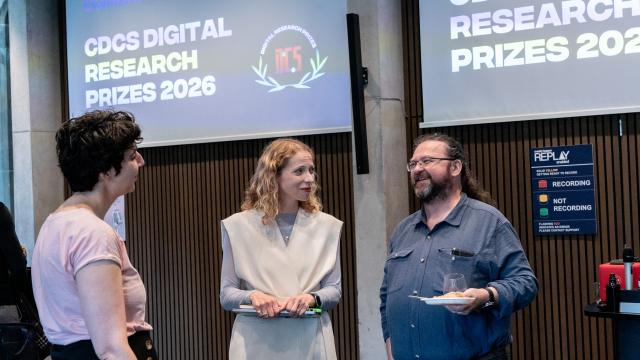
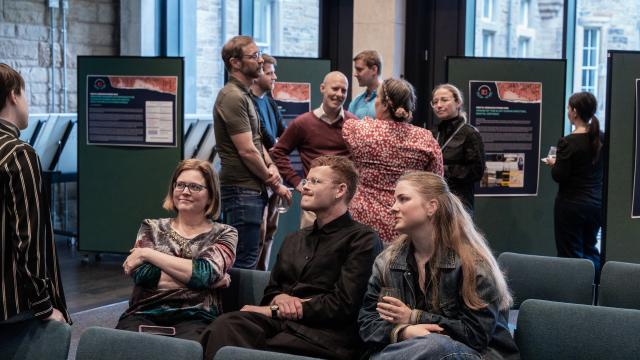
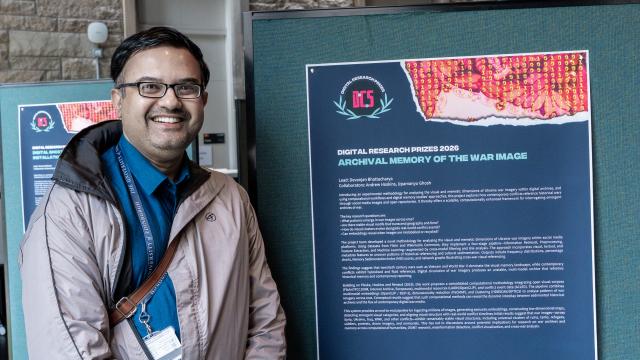
Event photography by Gintare Kulyte.
Announcing the Winners of the 2026 CDCS Digital Research Prizes
We are delighted to share news of the winners of the 2026 CDCS Digital Research Prizes. Congratulations to all our winners and to all those whose work was nominated!
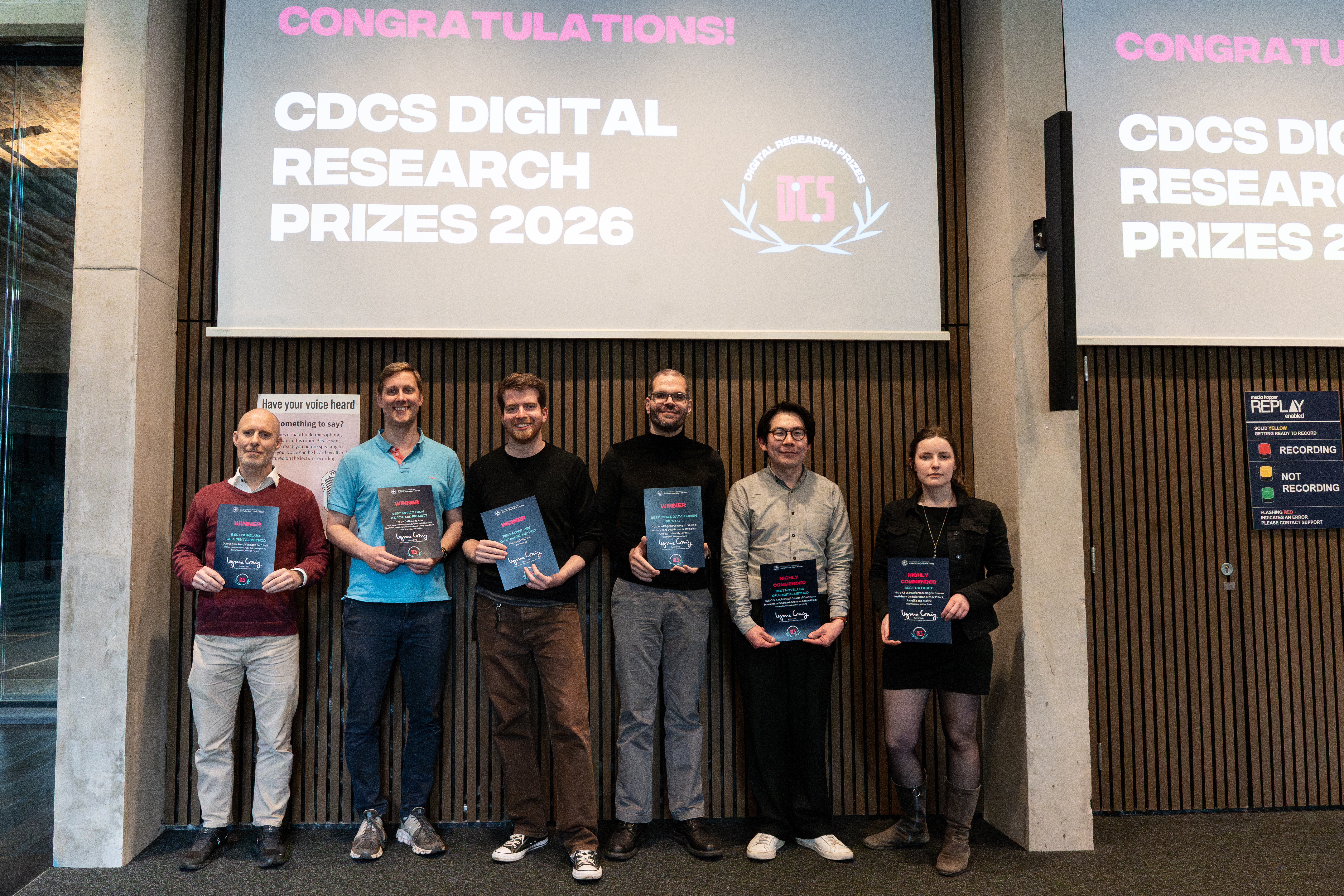
Event photography by Gintare Kulyte.
Best Small Data-Driven Project (joint winners): A data-led digital pedagogy in practice: Implementing data-driven learning in a Chinese university context" and "Digital Ghosts", practice-research and exhibition
A data-led digital pedagogy in practice: Implementing data-driven learning in a Chinese university context: Chinese undergraduates are frequently characterised as reticent or passive (e.g., Cheng, 2025), and international indicators suggest that English language proficiency remains a challenge in China. This small data-driven project researches a scalable response to this educational issue: a digital, evidence-led pedagogy that positions undergraduates as analysts of authentic language data and active participants in the classroom.
Digital Ghosts addresses questions about how messy, fragmented, and biased GLAM metadata can be meaningfully reused to communicate the scale and implications of web decay to non-specialist audiences. But everything stays on the web, right? No, the opposite is true: 50% of the web content disappears or becomes unrecognisable after a year. The team used creative approaches to web archival metadata to highlight these numbers, the gaps and absences in online representation, the power of platforms over our future collective memory, and the inevitable archival bias embedded in the more-than-heroic web archiving efforts.
Best Dataset: ICPSR-238545: Preschool Suspension and Expulsion Legislature in Oregon USA, 2021-2022
Nursery exclusion is one of the most serious yet understudied problems in American education. Each day in the United States, approximately 250 children under five are suspended or expelled, a rate more than three times higher than that of older students. These exclusions have lasting consequences for educational attainment, health, and economic mobility. The burden falls unequally: Black and Brown children, children with disabilities, those who have experienced adversity, and children from lower socioeconomic backgrounds face disproportionately high risks. Yet comprehensive data on legislative responses to exclusionary practices in Early Learning and Childcare (ELC) remain extremely limited. Although efforts to reduce or eliminate exclusion have been documented in more than 30 US states, fewer than ten have codified such efforts in legislation. Passing such legislation is complex: legislators must weigh consequences for children and families alongside pressures on providers, a workforce characterised by low wages and significant burnout. Limited data mean that many laws have relied on intuitive judgement rather than evidence. This dataset was created to help address that gap.
Best Data Visualisation: "Digital Ghosts"
In the physical world, traces of people are everywhere, marked in the tangible environment: footprints in the sand or broken twigs signalling a new path through the forest. Whether intentional or not, our interactions with the environment become part of it. Digital traces, however, are different. Despite their ubiquity, they remain difficult to detect. Websites are constantly created, modified, and abandoned, often without leaving a visible record. Unlike linear historical documents, they emerge, evolve, and vanish – leaving only fragments or shadows of their former existence. Web archives attempt to capture these traces through snapshots in time. However, because the internet is inherently dynamic, substantial gaps remain. Rather than treating this missingness as an error, the installation reframes it as a meaningful condition of digital memory, calling for visual and material strategies that make absence perceptible. As a response, this work translates web archive metadata into a durational, sensory experience. Websites are rendered as flows of light whose movement and duration correspond to each site’s lifespan and subject matter. These luminous data streams are projected onto cyanotype prints through UV light, which gradually develop on the gallery wall over 120 hours. When the projection ends, the prints are fixed, leaving behind physical artefacts that document the act of exposure.
Best impact from a data-led project: The UK Co-Benefits Atlas
The UK Co-Benefits Atlas is an open-access, interactive platform that maps the local social, economic, and environmental benefits of climate action across communities in the United Kingdom. Funded by Scotland Beyond NetZero, it is a collaboration between researchers from the Edinburgh Climate Change Institute, the School of Informatics, and the Edinburgh Futures Institute. The Atlas is based on the CO-BENS project, which models 11 key co-benefits linked to climate actions outlined in the Climate Change Committee’s Seventh Carbon Budget (2025). It provides localized projections for 46,000 communities, showing how benefits such as cleaner air, warmer homes, and improved health outcomes emerge over time. Featuring over 400 pages of visualizations, the Atlas covers 382 local authorities and 17 socio-economic indicators. It includes tailored data reports, interactive mapping tools for user-led exploration, and transparent documentation of methodologies, offering a comprehensive and accessible view of climate co-benefits. The Atlas is free to use, continuously updated. Since its launch, the Atlas has attracted over 3,400 unique users as of February 2026. The Atlas reached academics, policy makers and practitioners.
Best Novel use of a Digital Method (joint winners): Wasteback Machine and Opening the Well / Fosgladh an Tobair
The Wasteback Machine is an extensible JavaScript framework developed for measuring the size and composition of archived web pages. It repurposes the Internet Archive’s Wayback Machine as a research corpus, transforming what was previously a tool used largely for exploratory work within the digital humanities into a data-driven instrument capable of revealing the cumulative growth, materiality, and environmental impact of the web. The initial goal was twofold. First, it addressed the theoretical question proposed by Brügger of whether web archives can be reliably used for quantitative measurement, which was confirmed as a novel contribution following publication of the research paper. Second, the project aimed to demonstrate the cumulative environmental impact of websites and their ongoing growth, providing organisations with evidence to support more sustainable design decisions. The method was applied in empirical studies of United Nations organisations under the purview of the Joint Inspection Unit, as well as UNFCCC Conference of the Parties host country websites. The findings led directly to engagement with multiple UN agencies, including meetings with senior environmental and digital leads at the UN, ITU, UNEP, UNDP, and the UNFCCC. As a result, the UNFCCC has confirmed explicit reference to “sustainable web design” within the host country agreement annexes for COP31, based on recommendations outlined in our published paper.
Opening the Well is a significant digital humanities project that establishes a replicable model for how community-led heritage transcription can advance cultural access and technological innovation for minoritised languages. Developed within the University of Edinburgh’s ÈIST programme (eist.ed.ac.uk), Opening the Well ('Fosgladh an Tobair' in Gaelic) integrates automatic speech recognition (ASR) directly into a public-facing community transcription platform, using machine-generated first-pass transcripts to support volunteers in transcribing Gaelic oral recordings from major heritage collections. This is a transformative methodological intervention: Gaelic transcription has traditionally been slow, specialist-led and difficult to scale. By embedding ASR within a structured workflow -- including expert vetting, republication and model retraining -- Opening the Well creates a virtuous cycle in which human expertise and machine learning reinforce one another. The project’s contribution is already measurable. Since its launch on 2 December 2025, the platform has attracted over 50 community transcribers, who have produced transcriptions for 29 recordings comprising 18,429 words. Equally important are the ethical and collaborative frameworks that underpin the project, which involve partnerships between Tobar an Dualchais / Kist o Riches, the School of Scottish Studies Archives and the National Trust for Scotland.
See the full list of winning and commended projects in the 2026 CDCS Digital Research Prizes.